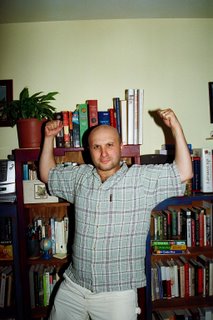
I first read T.C. Boyle's classic novel Budding Prospects in 1991 when I was a sportswriter in Maryland. I picked up my hardback copy for about five bucks at a used bookstore a few blocks away from the newspaper office one sunny spring afternoon. I flew through Boyle's comic masterpiece of ill-fated, paranoid pot growers in between covering high school baseball and softball games.
The novel resonated with me in ways that are hard to describe. I didn't grow pot, I'm not particularly paranoid and I certainly wouldn't be as inept at anything that I put my mind to as Boyle's characters are in their endeavours. There was a spark and a lightness in Boyle's language and his characters that struck me. The voice of the first person narrator, Felix, was direct, honest and humorous all at the same time. The spectre of failure haunted Felix from the opening sentences. I was at a difficult point in my life where I was getting by (sharing a broken-down house with two other reporters), but success in the adult world of work certainly did not seem assured. Maybe I was feeling a bit hopeless as I read Felix's opening words:
"I've always been a quitter. I quit the Boy Scouts, the glee club, the marching band. Gave up my paper route, turned my back on the church, stuffed the basketball team," Boyle writes. He continues, "I quit jobs: digging graves, pumping gas, selling insurance, showing pornographic films in an art theater in Boston."
A year later, I did quit my job at the newspaper and headed west to Colorado. My personal list of quitting had risen to include the cities of New Orleans and Houston along with a relationship and now my career as a sportswriter. Budding Prospects, along with about 75 other precious books, was packed away in the trunk of my car as I sped across the country with my friend's windsurfer tied to the roof.
When I
 left Maryland, I didn't even consider ditching my books. They were part of my identity. The battered copies of Bernard Malamud's novels helped me understand my Jewish ancestry. Joyce Carol Oates' Because it is Bitter, Because it is my Heart gave me some insight into racial relations in America. Richard Hugo's book of poems 31 Letters and 13 Dreams described the satisfactions and heartaches that lay ahead for me if I followed my most secret desire of becoming a poet. As I drove across America, I thought of Alex Kotlowitz's recently published instant sociological classic There are No Children Here: The Story of Two Boys Growing Up in the Other America that told me what was really happening in the inner cities that I sped past on the highway.
I treasured these books for how they had touched me as a reader and person, and I couldn't imagine being without them. I believed that I would refer back to them over and over again as the years went on. They were irreplaceable to me. You couldn't just go into any library or bookstore and find Hugo's poetry or Malamud's more obscure novels. I needed to carry them with me to create my own personal library.
I hung onto these books and added hundreds more over the subsequent 15 years. Budding Prospects was packed up and moved five separate times over the years. Each time it was placed on my bookshelf as if it was a valuable family heirloom saved in the Armenian exodus from Turkey by my great-grandmother. The bookcases in my condos grew from bricks and boards to beautiful painted wooden cases acquired at a Mexican furniture store in downtown Boulder. No expense was too great when it came to caring for my books. When those cases were bursting with titles, I installed metal brackets and wall-to-wall shelves on every available wall. Finally, when there were still books that couldn't find a home on any of the shelves, stacks started accumulating on the floor.
Then, a funny thing happened about two years ago -- I tried to reread Budding Prospects. As part of a store contest, every staff member was supposed to pick a backlist book to recommend for the summer. What could be a better fit for pot-smoking Boulder than my old beloved friend. I managed to get to about page 75 before I set aside Boyle's work in boredom. It seemed more meandering than I recalled, and all of the wonderful passages that I remembered held none of the surprise for me that they did on the first reading. Here was this book that I'd carried for over 2,000 miles and packed and repacked for the last 15 years and I had no desire to read it again.
I didn't immediately get rid of my copy of Boyle's debut novel. But I started thinking about all of my books. Why was I holding onto them? At the age of 40 I was much more confident of my identity than I had been at 25. I didn't need them to define me anymore. I never seemed to reread them, except for an occasional poem or short story. I didn't really refer to them very much. Some I even forgot I owned and would snag a remainder copy of a title that it turned out was sitting in our spare room collecting dust in its alphabetically correct place on the shelf.
Furthermore, even if I let go of Budding Prospects I could turn around and get it right back if I really wanted it. Over the last couple of months, I've gradually been dismantling my personal library. As I part with each precious tome, I'm addicted to looking up what it's really worth out in the world. It turns out that most of my books are worth between one penny and three dollars according to Amazon and Abebooks. That's not much when you consider how valuable every inch of an 800-square-foot apartment is in downtown Boulder.
Sometimes, I fear that as I get rid of them I will miss their physical presence. It will be like the fresh paint on a wall where an old picture used to hang. You might not even know what the picture was, but you miss the frame, and it's almost painful to see that clean spot on the wall. This worry was assuaged a bit last night over drinks with an old friend, a writer, who said goodbye to many of his books when he moved from a house into a 640 square foot condo with his wife.
"We packed up and got rid of so many boxes of books when we moved, and I don't miss them at all. There isn't a single thing that I miss," he said. I peered at him closely trying to figure out if I really believed him. "It's great," he blurted out in conclusion and grinned. He sure looked like a happy man to me.

It was reassuring to see him smiling; it is kind of depressing to think that these objects that have had a hold over me like holy relics or talismans for the past 15 years could be worth-less. On the other hand, it is freeing to think that I no longer need to construct a personal library. Every obscure Malamud novel can be had in several different editions.
I spent a couple of days during the last week receiving used books at the bookstore. I was amazed at the plethora of titles that comes in every single week. Classic works of literature, religion and history, along with books that are still on the bestseller list. If you want to get a cheap copy of Eckhart Tolle's Oprah sensation A New Earth or Junot Diaz's Pulitzer Prize winner The Brief Wonderous Life of Oscar Wao, just put in a request at our used book office and one will probably show up within a few days.
In the used book office, I felt like I was standing beneath a waterfall of books as I looked at the floor to ceiling shelves of books we'd recently purchased waiting to be received. As I stood there, I began to realize that there is a never-ending flow of books. There's no reason to dam up a tiny area for my own personal pool. For a modest amount of money, I can reach into this flow at any time and read exactly what I want.
The dismantling of my library hasn't gone that smoothly. There are still books that I've owned for 12 years that I insist that I will eventually read. My wife doesn't quite understa
 nd why I have to hang on to two copies of Don DeLillo's Underworld. I explain that one is the reader's copy and the other is a signed first edition. These are the hazards of my profession. I got rid of Budding Prospects, but I can't let go of T.C. Boyle's The Tortilla Curtain and Road to Wellville. They are both signed, personalized and dated. Then there are books like Kevin Canty's collection of short stories, Honeymoon. It's one of 250 signed first editions. I've never read Canty, but perhaps this will become a holy relic if Canty goes on to win a major award.
These books with personal touches seem to be all that I want to keep anymore. They seem to me to be irreplaceable in a way that most books simply aren't. I'd sooner sell my couch (my wife might disagree since she's currently napping on it) than my autographed Philip Roth books. But is this really a library? No. It's just a fairly random collection of signed or rare books that I've stumbled across in my years as a bookseller. The world, for better or worse, is now my library.


 Posts
Posts