Saturday, March 31, 2007

Read our Manuscript, Please

Book manuscripts are large, unwieldy, ugly and frequently riddled with typos. It's not often that I'm willing to venture into the belly of one of these double-spaced behemoths, made even more intimidating because only one side of the paper contains print. What will eventually be a slender 250-page novel, appears to be 500 pages in manuscript form.

I receive a handful of these overgrown, bound term papers each year at the store. They are usually by authors that I've shown a great fondness for, like Wendell Berry. I gaze longingly at these works, and my wait for the hardback book is all the more painful knowing that my guru's words are sitting right on my desk but in a form that I can't bring myself to read. Occasionally, the manuscripts are by unknown writers and come festooned with candy bars, playing cards or perfumed sachets with frilly ribbons. Once the extras have been doled out among the office staff, a debate usually ensues about whether or not the manuscript can go into the paper recycling with the binding still intact.

About six weeks ago, I received the manuscript of Brock Clarke's forthcoming novel, An Arsonist's Guide to Writer's Homes in New England. I had responded to an email from an acquaintance at Algonquin Press looking for readers. I'm not sure why I said I'd be willing to look at the book. Perhaps, I feared that some day I'd be stranded, penniless, in North Carolina and would need a job. Where else, but to Algonquin, could I go in that situation? If I could just get the bus fare to Chapel Hill, I'd have a favor to call in. I'd be saved.

Clarke's tome arrived, and it terrified me. It is almost the exact same dimensions as the Boulder phone book -- that's the white and yellow pages combined, with listings for Louisville, Longmont, Nederland and a half-dozen more towns. How could I possibly read this? I did the only rational thing possible; I hid the book beneath of pile of reader's copies (that I also would never read) on the side of my desk. There it languished, nearly forgotten, until another email showed up a couple of weeks ago reminding me that Algonquin's sales conference was approaching, and whenever I had any feedback, even if I detested the book, I should send it along. That part about detesting it meant there was no way to get out of this gracefully. My God, the woods of North Carolina were closing in. If I ignored this latest email, I would somehow be sentenced to a lifetime of menial labor in Charlotte or Durham as poetic justice. I swiftly emailed that I was just getting started on Clarke's potential magnum opus and that I'd have a quote soon.

That night I began reading An Arsonist's Guide while lying in bed. My wife looked askance at the huge weight pressing the covers down over my chest. She wanted to know if I was really going to "read the whole thing." I told her that it wasn't as long as it looked and sighed as the spine pressed into my sternum. I stared up at our immaculately painted ceiling and thought about the last manuscript I had read in its entirety.

We were having the ceilings and hallways of our condo painted a couple of years ago. The lead painter, Robert, was an ex-New Yorker. I liked his brash, direct manner and the confidence that he had when advising us on color choices. We were thrilled by how much nicer our condo looked when the painting was completed. As Robert and I were doing a final walk through, he asked me about all the books we have. I told him that I was the buyer for the Boulder Book Store. His eyes lit up and an almost impish grin crossed his face.

Robert was a writer. I shifted my weight from foot to foot as he described his different science fiction novels and their new-age tilt. I scratched my head when he inquired if there was a market for them. I almost jumped out the window when he asked if he could give me a manuscript to read. I was a bit surprised that he really had a manuscript. Most writers that I meet like this (well, not quite like this, but people at parties, in bars, at the gym), haven't exactly finished their masterpieces. Robert, however, had a half-dozen finished novels that I could choose between. After imploring me to "read just 50 pages" and strongly hinting I could get a deep discount on having my cabinets painted, I told him I wanted his most down-to-earth manuscript. That was a tough request for a writer who's "out there" in more than one way.

A few days later, he showed up at the bookstore carrying a large black binder. His manuscript, The Astral Imperative, was clamped in a hardback case that could serve as a book cover or be opened like a clam shell and taken off, leaving just the loose manuscript pages. He spent an awfully long time making sure I knew how to operate this marvel of technology, and after accidentally clamping my finger in the case, I assured him I'd read the first 50 pages and get back to him.

I ended up reading his whole book. It was a fascinating look at a manned mission to Mars in the near future. His characters were believable, his writing fluid and his plot riveting. My favorite part of the novel was a computer game that picked up on the thoughts of the astronauts and projected them onto a holographic image of the red planet. It was meant to be a way for them to work through the anxieties and expectations of their mission, but it soon turned more sinister.

I don't read much science fiction, but I can honestly say Robert's novel was better than two-thirds of the novels I've read over the past few years. That's saying something, because I'm often reading fiction that is highly touted by reps I trust, by editors I respect or by rave reviews in the The New York Times, The New Yorker or Harper's. Perhaps it is my lack of familiarity with the genre that led me to such a high opinion of The Astral Imerative. Maybe many other science fiction novels are well-written, thoughtful, realistic looks at the near future. Somehow, the lurid covers featuring bizarre aliens and absurd titles make me think that's not really the case. Now that I think about it, maybe I'd read more science fiction if it came coverless, like a manuscript.

I did everything I could to get Robert published. There's not a whole lot I can do since I don't know any agents. I gave the book to a few reps, and I talked it up to a few marketing people, but it never really got anywhere. Looking back, it's hard not to think of the irony of these two manuscripts. Algonquin is trying to get bookseller quotes for a novel that they are already committed to publishing, while my toiling painter has a manuscript with a great quote and the full endorsement from a bookseller, and he can't get a sniff from a publisher.

Anyway, back to Brock Clarke's novel. As I waded into the world of Sam Pulsifer, Clarke's narrator, and the man who accidentally burned down Emily Dickinson's house, I was struck by the even tone of this absurdist story. Pulsifer is always doing the wrong thing at the wrong time. He casually explains this away with assurances that he is a born bumbler.

There were aspects of the novel I dearly loved, including the idea that there are people all over New England who would love to see a famous writer's house burned down because they either hate the curator or tourists tramp through their yard to get to the house. I recently visited Faulkner's house outside of Oxford, Mississippi and noted how isolated it was from most everything else. But in New England, as in my home town of Philadelphia, the historic house might be the one right next to yours.

I also enjoyed the playful allusions to the different writers, and Pulsifer's mother's take on different works of literature. The poor woman is an English teacher who has to endure the mortification of knowing that her son burned down a literary landmark. Entangled in all of these literary wanderings is a mystery. More writers' homes are burning down, and Sam is not responsible, although he is acting guilty.

I was reminded of Marisha Pessl's marvelous first novel from last year, Special Topics in Calamity Physics, with its numerous references to real and imagined books, and also it's unravelling, mysterious plot. Both novels also have a visual, almost cartoonish, appeal. At times I thought Clarke's novel could work better as a graphic novel. In Special Topics, Pessl includes drawings and illustrations to illuminate what mere words can't do. Perhaps both of these books will find their way into the movie theater.

In the end, I guess I felt that An Arsonist's Guide was an engaging and thought-provoking read, but that it needed some work. The characters seem too thinly drawn even for a satire, and I got really tired of all the silly drinking that went on. About midway through the novel, the characters just drink lots of beer, and it makes them pretty stupid without contributing much to the plot. I was tempted to mark things in the margin and send it back in, but then I realized I'm not being asked or paid to play editor. I'm being asked to send in a quote.

I was able to send a positive blurb because I did enjoy the book, and I do think it will appeal to many people. I managed to read it in just a couple of days, and my motivation for finishing it that quickly was the writing, not the weight of the manuscript.

Sunday, March 18, 2007

Reading in the Middle of Nowhere


Each winter, I ski into one of Colorado's Tenth Mountain Division huts with my wife and group of good friends for a long weekend. These huts are only accessible by skis or snowshoes (although hardly anyone ever snowshoes) and are usually three to seven miles away from the nearest road. The huts are set in beautiful mountain meadows with fantastic views of rugged peaks. In these mountain retreats, you truly get the feeling of being away from the world. There are no phones, televisions, radios, computers or newspapers in these overgrown log cabins.

Of course, it's not completely rustic. The huts are more like chalets. At night we play cards beneath lights powered by a battery that is recharged every day from the abundant solar energy. We cook our meals over propane burners in cast iron cookware; we heat the cabin with two large wood stoves (that definetly were trucked in); and when nature calls, there is a spacious outhouse that doesn't even smell that bad in the dead of winter. The real selling point for the huts, though, is the living rooms, with their large windows and comfortable benches covered with mattresses and pillows. Ahh . . . it's worth hauling a 35- to 40-pound backpack up a mountain when you know a warm fire and spectacular views are waiting.

Each year, I spend more time fretting about what I am going to read than about any other aspect of the trip. The young, strong guys, like my friend Ram, just bring whatever they happen to be reading, even if it's a hardback economics book. One year, our group included a high school senior, an excellent skier in fine shape, who thought nothing of carrying up a few text books so he wouldn't fall behind on his homework. That's not for me. I scan my bookshelves looking for something small and sleek. I haven't gotten so weak that I prepare for the trip by shopping for Dover classics yet, but once I did end up bringing a Dover edition of Henry James' Turn of the Screw.

Other than the weight factor, I've come up with a few rules for my hut trip books. These trips are incredibly social, and most of the reading is done in small snippets of time between conversations, bridge playing, bringing in snow to melt for the hut's water, cooking, cleaning and skiing. Complex novels and theoretical nonfiction don't work well. That eliminates all Faulkner, physics and philosophy for me. Anything with arcane language is going to be tough, unless someone in your group wants to schlep the Compact Edition of the Oxford English Dictionary up a mountain so you can decipher James Joyce. It was for this reason that my foray into the Jamesian ghost story was a failure. I find that contemporary short stories, humorous essays and entertaining short novels work the best.

The two best hut trip books I ever read were Steve Kluger's wonderful baseball novel Last Days of Summer and Hash by Torgny Lindgren. Kluger's novel, which I read in its hardback form over 10 years ago, consists of letters, quizzes, clues, postcards, lineups and news articles. It was easy to cease reading at any even given moment, and its young protaganist was both heartbreaking and entertaining. Lindgren's Hash was a rather bizarre novel about two men, one the Nazi, Martin Borman, searching for the best hash (a dish consisting of hooves, offal, entrails and grain) in rural Sweden in 1947. The narrator was an ex-reporter, who at the tender age of 107, was determined to finish his ultimate column. Hash also featured fabricated news stories and a huge dose of humor.

This year, as I searched my shelves, I came up with two titles (yes, I bring two books -- if you are stuck with a lousy title, you are really stranded in the middle of nowhere with nothing to read.) I selected an old out-of-print book, Howe & Hummel: Their True and Scandalous History that I needed to read for a book group that I am in. We usually don't read out-of-print titles, but the group's average age is about 70, so I wasn't going to argue with the choice. Just in case that proved to be unreadable (I was rather worried about getting through a 60-year-old book about two criminal attorneys from 19th century New York), I also threw in William Boyd's slender collection of short stories, The Destiny of Nathalie 'X'.

I felt that both these books fit my criteria. Howe & Hummel is really four New Yorker pieces by Richard Rovere that were written in the 1940s and compiled into a book in the late 1940s. I have a Farrar, Straus and Giroux edition with an introduction by Calvin Trillin that was reprinted in 1985. I hoped that Rovere's articles would read like pithy essays. My other choice, the short story collection, is by one of my favorite writers, and this particular book by Boyd features a wide variety of topics and styles. Well, I never dipped into the Boyd because I was so enthralled by Rovere's accounting of the two slippery attorneys.

William F. Howe and Abraham H. Hummel were the two most notorious lawyers of their day. In appearances, they were a study in contrasts. Howe was a large, flamboyant man, given to wearing lots of diamonds (cufflinks, buttons, etc.), while Hummel was a small, almost deformed man, who preferred to work behind the scenes. Rovere tells how they came to represent virtually every New York criminal (their offices were right across the street from the jail, and it was often the first stop for escaped convicts) and also how they came to dominate the show business litigation.

These guys basically got away with murder. Hummel had a whole business where he would send detectives into the back rooms of theaters looking for show girls that had slept with rich men. When they found one, they took an affadavit from her, stating that the man had bedded her under false pretenses. Hummel would then summon the man, show him the affadavit and say that unless he settled for a large sum of money, there would be a breach-of-promise suit. The men always settled, and Hummel got half the settlement money.

Howe litigated the criminal cases. He had a whole host of actors on hand to play the accused person's wife, children, devoted parents or any other relation that might help his client in court. They would cry, swoon or just look plain miserable as the jury tried to decide the case. He conjured up entire families that would go destitute if his client were put in jail. Usually, the famished family had never laid eyes on the accused man until they entered court on the day of the trial.

Coming from a family of lawyers, I absolutely loved the accounts of these two guys' shenigans. They even had a code of ethics that they would not deviate from. Hummel would never let a woman threaten the same man twice with a breach-of-promise suit. He had the showgirl sign a self-incriminating statement once the settlement was made. If he heard that she was trying to sue again, he would forward the statement to the man's lawyer.

When there was nothing in the law to enable them to win the case, Howe and Hummel invented new things. Howe pioneered the insanity defense as a way of representing killers who couldn't claim their crime was an accident, suicide or a case of self-defense. Howe also came extremely close to getting everyone on New York's death row freed due to a technicality in a new sentencing law he discovered. Only an emergency measure passed in Albany stopped it from becoming open season for first-degree murderers.

This is a perfect little book, and it saddens me that it is out of print. Rovere's articles aren't padded with unnecesary filler or ornate prose. It's hard to imagine a lawyer, or anyone interested in urban history, that wouldn't enjoy Howe & Hummel. It was certainly a balm to me on this year's harder-than-expected hut trip.

We were at the Tenth Mountain Hut, which is usually an easy three-mile ski from near the old mining town of Leadville, but the weather conditions were just atrocious. It was a cold day, and the temperature kept dropping as we headed up the trail. It was so cold that it was dangerous to stop and eat. When I did manage to take a few bites of my sandwich, I found that it was more like a popsicle. It was also a constant battle to keep the tube of our Camelbak from freezing up. For the first time on a trip like this, even the water in our regular Nalgene water bottle froze. Usually, the problem with these trips is that you are too hot, skiing uphill with a pack on, and you constantly have to strip off layers. This time, when we got to the hut, I was wearing all of my clothes: it was 5 degrees below zero, windy and snowy. I needed a warm fire and a good book. Luckily, this year I had both.

Sunday, February 25, 2007

The Day Eloquence Died in Dallas

The marshes just north of Cape May, New Jersey were off to my right as I sped up the Garden State Parkway last August in the passenger seat of my father's air-conditioned, 1990s Jaguar sedan. A great blue heron daintily picked its way through the reeds, its long neck swaying ever so slowly as sea gulls swooped in from overhead and the long grasses blew back and forth in the early evening breeze, undulating like waves in the middle of the ocean. I was mesmerized by the scenery, particularly the vibrant greens and blues that were lit up by the day's dying sun rays.

I looked over at my dad, effortlessly driving. He was dressed in a button-down shirt, nice slacks and gleaming black leather shoes, a casual outfit for a Philadelphia lawyer. He didn't seem to notice the gift of nature just beyond the car's window. His eyes were on the road, but his mind was back in the early 1960s. His full attention was focused on the words of John F. Kennedy booming through the stereo speakers. Pure joy lit up his face as Kennedy's clipped upper-class New England accent came to us as clearly as the day's news on the radio.

It made me happy as well. After all, I was the one who had given him Let Every Nation Know: John F. Kennedy in His Own Words by Robert Dallek for Father's Day two months earlier. It was clear that my dad knew the compact disc that came with the book by heart. When Kennedy's speech came on regarding the integration of the University of Mississippi, he put his fingers to his lips when he sensed that I was about to interrupt. When the speech ended, he said to me, "See how he did that. He included everybody. It was all of our responsibility to make sure that there were equal rights. It wasn't divisive. It was everyone's problem if one man was denied his rights."

I sat silent for a moment. I was amazed by Kennedy's words, not necessarily by their content, but by the words themselves. He assumed that he was speaking to an intelligent audience. His vocabulary would make an English professor proud, and yet he was easily understood. His words moved me. Me, the cynic who regards him as overrated. After all, I have rebelled against the mythology surrounding him for as long as I can remember. But here was a voice that beckoned. He peppered his speeches with phrases that make you stop and ponder and hope.

I told my dad that it made me sad to listen to these words. He assumed I was speaking of the assassination, but I wasn't. "No one speaks like that anymore," I said to him. "Clinton just droned on and on. His speeches were more filler than substance. I hated Reagan's 'aw shucks' act, and Bush truly sounds like a moron compared to Kennedy. It would be even more embarassing if you actually agreed with anything Bush said." As the sun glinted off a canoe in the marshes, I realized that our country's biggest problem might be that politicians don't believe in the people anymore. At least not the way Kennedy seemed to in those speeches.

It took me a few minutes to regain my equilibrium and step back from the abyss that is the Kennedy mystique. We were closing in on the diner where we would meet up with my wife and my sister's family for dinner. They were driving in my sister's minivan; perhaps they knew it was going to be a Kennedy-fest in the Jaguar. Immediately before leaving for the restaurant, my sister and I had given my dad his birthday present: a Kennedy action figure that sported a replica hand-crafted suit and came with a mini-biography and a timeline. Its best feature is that when you push the wool suit's lapel the President's unique vocal cadence comes to life, and the doll flawlessly delivers a dozen of his most famous phrases.

As we turned off the Garden State Parkway and Kennedy launched into a commencement address, my dad turned down the sound. "You know, I really think that Oswald acted alone," he said. I couldn't believe what I was hearing. He had advanced every crackpot theory on the assassination since I was 10 years old. For awhile it was the Cubans, then it was the Russians, then it was the Russians and the Cubans, then it was the mobsters. He even entertained my crazy theory that it was Lyndon Johnson and the Texans. We had examined every angle, from Jack Ruby's murder of Lee Harvey Oswald, to the grassy knoll, to the magic bullet theory, endlessly ruminating on the same facts and opinions until he'd come to the same conclusion that something just wasn't right. It was fishy. Fishy enough to fill a library with all of the tomes that I had given him and that he had eagerly read over the years. Including Gerald Posner's 1994 Case Closed that concluded Oswald had acted alone. My dad had quickly dismissed it at the time.

When I was 13, my father had a court case in Dallas. He took me down for the trial, and during the days, I ran around the book and record stores in town, swam in the hotel pool and drank enough Dr. Pepper to drown a small dog. In the evenings, we drove the route of the motorcade, slowing down in Dealey Plaza as my father measured out the distance to the grassy knoll in his mind and craned his neck back to see where Oswald's shots emanated from. Over and over again, we drove the route, as the rancid soda bubbled up in my throat. He gripped the wheel and muttered about how it didn't make sense, they were hiding something.

We finally arrived at the diner and stepped out of the car, into the sea-side humidity to wait for my sister. When I asked him how he had come to the conclusion that Oswald had acted alone, he simply said, "It's the only thing that makes sense." When I prodded him a little more, he told me that someone would have cracked by now if there was a big cover up. That, of course, had been my exact theory ever since giving up the Texas conspiracy 25 years ago. I decided not to remind him of that, as my adorable nephew and niece came bounding out of my sister's car and running over to us.

My Father's Day gift this year will reinforce his new belief about the assassination. Vincent Bugliosi, the author of Helter Skelter, the riveting account of Charles Manson's crimes, is weighing in on the Kennedy assassination with Reclaiming History. Bugliosi, a lawyer, prosecutes Oswald in the murder using forensic evidence, a reexamination of key witnesses and a healthy dose of common sense. In W.W. Norton's catalog copy, we are assured that in his 1,632 pages, Bugliosi picks apart every conspiracy theory, and that he will "shed fresh light on this American nightmare. At last we know what really happened. At last it all makes sense."

The book sounds huge, but I wonder how many pages you could fill with all of my father's thoughts, conjectures and ruminations on the assassination. Would 10,000 pages even be enough to cover all of the different conversations he has had on the topic?

All I can say is that it's about time that someone makes sense of it all. It's time for everyone to stop inventing paranoid conspiracy theories and perhaps try to understand just what it was that we lost that day in Dallas. It seems to me that the politicians have never forgiven us for that day. We are perpetually being punished by our nation's rulers with pandering platitudes and an endless barrage of inanities. Isn't there anyone out there who can treat the public with respect? Isn't there anyone who will say something -- anything -- as intelligent as Kennedy used to? Whether you agreed with the man or not, you can't help but appreciate his words.

Perhaps that's asking too much. Maybe it's enough to know that this summer I will be back in Cape May with my family, and as the sun sets on another fine day, my father will start up the endless conversation about the wonders of John F. Kennedy. I will hold silent for a moment, allowing the myth to take hold before I mention how he set Vietnam in motion, blundered on Cuba and hesitated on civil rights. Ah, but he did it all so eloquently.

Saturday, February 17, 2007

The Angst of Winter


This year, Colorado's winter is relentless. We opened with 33 inches of snow the week before Christmas, and we've suffered through at least a half-dozen snow storms since. Valentine's Day was cold and miserable, and yesterday, one of the nicer days of 2007, featured wind gusts of 75 miles per hour. It would be a great time to hibernate with a good book. Unfortunately, hardly anyone can get themselves into the book store to find one in this miserable weather.


We've had a few brief thaws over the last few weeks, most notably Elizabeth Gilbert's appearance to promote Eat, Pray, Love. Almost 300 people (290 women) were crammed into our ballroom, and while a storm raged outside, the temperature inside soared up to 80 degrees as Gilbert told of her trips to the warmer climes of India, Indonesia and Italy. In the audience, coats were removed, sweat was wiped from brows and books were clutched in moistened palms.


But for the most part, it's been a harsh season. The back story of the past two months in publishing is even worse than the gloomy weather. One of the nation's top wholesalers, Advanced Marketing Service, has declared bankruptcy, and a look at their list of creditors is almost a complete roster of American publishers. Random House is at the front of the line with more than $40 million owed to them. HarperCollins and Simon & Schuster also have a lot of money sitting out there. Further down the list are dozens of small and medium sized publishers that might not be able to stay afloat if they are forced to write off large invoices.

All of this has made for a squeamish buying season. The books we have aren't exactly flying off the shelves because we've made a habit of closing the store early due to ferocious storms, the publishers are getting skittish about their marketing funds and author tours because they are out millions of dollars, and to top it all off, Advance Marketing Service owns Publishers Group West, which is the distributor and sales force for hundreds of key small presses. It was sad to page through the PGW catalog the other day while my sales rep was trying to put a dignified face on the impending doom of the company as she told me which books were "postponed" because there wasn't enough money to print them.

I'm looking forward to spring in a way that I have not done since moving out to Colorado and learning to ski 15 years ago. Only one thing really keeps me going these days:

Pitchers and Catchers Report

Spring training opened on Thursday for most Major League teams. My favorite squad, the Philadelphia Phillies, is hoping to improve upon last season's second-place finish with an influx of new pitching, an emphasis on fundamentals and perhaps a few prayers thrown in. This is the Phillies' 125th season, and the team has managed to win only one championship. But here in the chill of February, I feel optimistic that number two is possible.


To prepare for the season, I read Baseball: A History of America's Favorite Game by New York Times reporter George Vecsey. I actually read this out loud with my wife. She did most of the reading while I closed my eyes and imagined sun-dappled Ebbet's Field in 1954 or Babe Ruth slicing a line-drive homer through the humidity of Yankee Stadium in 1927.

It's a miracle that my wife read a baseball book. She's not really a sports fan, although she has grown tolerant and even a little fond of college basketball after being dragged to the University of Colorado games for the last six years. [Editor's Note: I beg to differ. More than just "a little fond," I have become quite a fan of college basketball. I am even looking forward to March Madness with great anticipation.] The baseball book arrived in the mail one day last summer, and as I was cooking dinner (there is a price to pay for taking your wife to countless sporting events) she started reading the preface about Stan Musial. She was hooked by Vecsey's poetic language, his gift of storytelling and his description of Musial's bizarre corkscrew batting stance.
Vecsey, in chapters that read almost like perfect self-contained essays, recounts the history of baseball from its pre-Civil War roots, to the 1919 Black Sox scandal, to Jackie Robinson's breakthrough with the Dodgers in 1947, through today's steroid-plagued summers of Barry Bonds. My wife would frequently look up from the page to comment on the writing or the colorful history of baseball and ask me an insightful question about interleague trades or the designated hitter. In those moments, it almost seemed that she understood the mania that takes hold of me every spring when I know that we are on the verge of a new chapter of baseball history. Perhaps she will come to forgive me for never failing to point out, whenever our wedding is mentioned, that the Phillies were in first place on the day we said our vows.

I am also reading Donald Honig's Baseball: When the Grass was Real. Honig's book is a series of first-person narratives of Major League players from the 1920s through the 1940s. Written in 1975, when astroturf fields were the norm, the title seems curious now that every park in the National League is back to real grass. Honig owes a debt to Lawrence Ritter's classic, The Glory of Their Times, which was written in the 1960s and features players talking about their experiences during the turn of the twentieth century.


The most touching story in Honig's book is told by Wes Ferrell, a great pitcher from the 1930s. Towards the end of his career, Ferrell was traded to the Yankees, and he was in spring training when Lou Gehrig's body began to fail him. Gehrig was known as the Iron Horse, the strongest player in all of baseball, a player who never missed a game in 14 seasons.

"In workouts you'd see him straining and huffing and puffing, running as hard as he could, and not getting anywhere. The fellows would laugh and kid him. 'Hey, Lou, you're getting old.' That sort of thing. Nobody knew the truth." By the end of training camp, as the players begin to realize Gehrig just wasn't the same, Ferrell writes of seeing Gehrig walking across the grass in tennis shoes rather than cleats: "he was sliding his feet as he went along, instead of picking them up and putting them down. Looking back now, I realize why. His muscles were so deteriorated that just the effort of lifting his feet a few inches to walk had already become too much. God, it was sad to see -- Lou Gehrig having to slide his feet along the grass to move himself."
Almost every year baseball breaks my heart. I don't mean little disappointments, like a summer romance falling apart because the sweethearts are headed off to two different colleges. I mean the kind of hurt where you lie awake half the night for weeks, replaying how things went wrong. Either the Phillies don't make it to the playoffs, or if they do, they meet some dramatic ending like Joe Carter's series-ending homer in 1993 for the Blue Jays that gets replayed over and over again in highlights shows every year.
In the cold days of winter, as the players start playing catch in Arizona and Florida, it makes you feel young and vigorous just to watch them whip the ball back and forth in a perfect line. But by the end of August, when teams are scraping by day-to-day just to stay in the pennant race, half the pitchers hindered by nagging injuries, some even lost for the season, and a favored aging hitter can't catch up to some minor leaguer's hotshot fastball anymore, you realize what a fantasy it all is. We are all destined to shuffle along the grass eventually.

It's that realization that always sends me scurrying back for a good novel as the leaves begin to fall and I need an escape from the physical realities of the world. It's what makes winter so peaceful and almost healing. All those pitchers will come back with fresh arms, and maybe the aging slugger, who is actually a few years younger than I am, just had an injury he wasn't telling anyone about. His swing will be as good as new, now that spring training is here again.

Friday, February 09, 2007

The Emperor's Critics


I was mesmerized last weekend reading Claire Messud's new novel, The Emperor's Children. That was surprising, because it took me a week to read the first 100 pages or so. But suddenly I became absolutely absorbed in the escapades of the single, forlorn, thirtyish Marina, Danielle and Julius as they negotiated the trendy world of pre-9/11 literary New York. This doesn't usually happen to me. I'm a very measured reader. I don't typically enjoy books where every chapter ends on a note of suspense.

The Emperor's Children's plot doesn't feature mysterious twists and turns, but I constantly wanted to know what happened next with these characters and their little intrigues. Messud is a dexterous writer, and she handles her characters and various storylines with great aplomb. The most fascinating characters are the outsiders who upset the cosy little world of petty jealousies that the three friends from Brown University have fallen into.

Marina's father, Murray, a famous left-wing essayist and journalistic adventurer, starts a secret email correspondence with his daughter's best friend, Danielle. Marina's cousin, Bootie Tubb, a fiercely idealistic and unrealistic autodidact, holds everyone, especially Murray, to his extreme standards of academic purity and moral truth. And finally there is the slimey Australian Ludovic Seeley, who has come to the United States to foment a revolution by editing a cultural magazine, financed by a Rupert Murdoch-like magnate. Like Bootie, Ludovic's magazine also seeks to expose the truth. Ludovic is both repelled and fascinated by Murray, and he has eyes for the beautiful Marina.

It's all a satirical literary soap opera with priveleged people who have managed to delay growing up, grousing about the truth while sipping wine. How did I become so fascinated by it? I think, that I, too, was drawn in and revolted by Murray. He's a man who loves to live, a man who is often in the moment, so much unlike the characters in his daughter's generation. Would Booty or Ludovic manage to bring him down to their own narrow opinions of truth and morality? Would his affairs be exposed and he be shown for a hypocrite?

In the end, most of this is seen for its petty posturing. When September 11 comes, it changes the world for all of these characters in profound ways. I give high marks to Messud for seamlessly using 9/11 as a plot device. It seems natural, and although it is rendered as a tragic event, it turns out to be strangely freeing for at least one of the novel's characters. I find it interesting that today's New York, with its status scuffles and celebrity obsessions, more closely resembles the pre-9/11 world of these characters than the world immediately after 9/11. At times, I had to remind myself that I was reading about a naive world before Islamic terrorism had hit home. How quickly we've reverted back to old habits in some ways.

By Sunday morning, I was shocked to find that I had finished the novel. It was supposed to last me through the entire weekend. I was suffering from separation anxiety. In desperation, I turned to the internet, in hopes of reading about Messud or maybe even hearing an interview with her. In my search, I stumbled upon a wonderful site for reviews and information on books, movies and other cultural affairs called metacritic.com.

For Messud's book, there were dozens of links to reviews on the site. The site shows the first paragraph of each review, then notes whether the review is positive, negative or mixed. For the second time in one weekend I was transfixed, as I pored over review after review (almost all positive.) In fact, the only outright negative review came from the Sydney Morning Herald. Perhaps the depiction of the sleazy Australian biased them against the book.

The site also gave The Emperor's Children an overall score of an 85. What the heck is that, I wondered? It turns out that the site assigns a score to each review based on how positive or negative it is. It then tabulates the various reviews that a book gets from newspapers and magazines around the world into a single score. Messud's rating placed her ninth among books released in 2006 that had received at least seven reviews. I was surprised that it placed that high. A few of the characters, most notably Marina's gay friend Julius, were under-developed. And while I haven't read 10 books better than Emperor's Children in 2006, I sure hope all of the combined reviewers have.

Here are the top 10 reviewed books for 2006 from metacritic.com.
1. Suite Francaise by Irene Nemirovsky.
2. The Road by Cormac McCarthy.
3. The Night Gardener by George Pelecanos.
4. Hollywood Station by Joseph Wambaugh.
5. The Thin Place by Kathryn Davis.
6. People's Act of Love by James Meek.
7. The Looming Tower by Lawrence Wright.
8. Heat by Bill Buford.
9. The Emperor's Children by Claire Messud.
10. After This by Alice McDermott.

Sunday, January 21, 2007

Return to Sender

Box it up and send it back

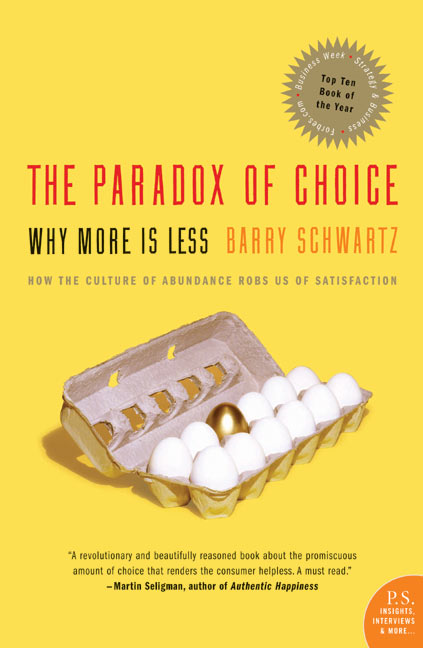
We live in a returnable, refundable, rebatable world. If you don't like your new stereo, box it up and bring it back to the shop. If those new shoes, bought from a catalog, don't fit like you expected, send them back. If dinner wasn't perfect, lobby your waiter for a free dessert. If you are unhappy with your spouse, well . . . divorce him or her and start looking for a new one. All of this returning makes us less, not more happy and fulfilled, according to Barry Schwartz in his book Paradox of Choice.


According to Schwartz, we think there is always something better behind "Door Number 2" in our society. We might be better off if we learned to live with what we've got. We might learn to love the foibles of our new television, rather than plotting its return, if we knew we were stuck with it. We might be more forgiving of our spouse's quirks if we were going to live with them for the rest of our lives.


In the past few months, I've been ruminating about these issues in a slightly different way. Could the publishing business and bookstores be more profitable, and thus happier, if they started moving away from a returnable model? Right now, 90% of the new books the bookstore buys can be returned to the publisher for credit.

I'll be the first to admit, this results in over-buying and it leads book buyers to have very little patience once the books are in the store. If a new hardback hasn't started selling in the first few weeks, I'm already contemplating its return. By two months, I've seen enough: it's outta here. There's no commitment. There's no love. If we truly owned those books, I'd try a lot harder to sell them. We would discount them, we would turn them into used books, and we would stack them on the remainder tables. It wouldn't exactly be love, but it might be more profitable if the publisher were providing some incentive for buying on a non-returnable basis.

We are at the beginning of a new buying season, and I've been asking all the reps what their publishers' terms are for purchasing non-returnable. You'd figure that buying and not returning would be something that publishers would want to encourage. After all, publishers are swamped with returns and often sell them for pennies on the dollar to remainder companies.

The publishers offer greatly varying incentives. Hachette (formerly Time Warner) has a generous non-returnable discount, but Penguin and W.W. Norton just give the tiniest smidgen of an extra discount for buying books as non-returnable. When I asked the Norton rep about this she had a reasonable explanation. Norton is a publisher whose livelihood depends on the sales of midlist books: those with smaller print runs, such as more literary novels and those by first-time authors. So Norton fears that if stores buy on a non-returnable basis, they would be less likely to take a risk on these titles. This is a legitimate concern, but surely there must be some way around it. Perhaps, the discount on the whole order could be tied to the percentage of these midlist titles that a store is willing to buy.

With Hachette's extra discount, plus the savings in freight from not shipping hundreds of books back, we can come out ahead, even if we don't change our buying methods. Everyone would win. According to my calculations, which are based on how many books we return and common sense, if a major publisher offered an extra 6% discount, that would usually make it worthwhile to buy non-returnable.

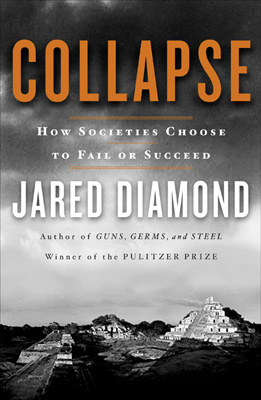
I have another reason, beyond pure profit, that I'd like to see the industry go towards non-returnable incentives. It seems criminal to me to be shipping these books back and forth and back across the country. That's a lot of fuel, in a time when oil seems especially costly. It's no accident that we are at war in Iraq and that drilling in the Arctic comes up every year. We are also cutting down a lot of trees for books that no one wants. It is with rueful irony that I noticed that deforestation is one of the major factors failed societies have in common with each other, according to Jared Diamond's Collapse.

Z is for Zorro and his travels

Here's an example of the current system: We are selling Isabel Allende's hardback Zorro as a remainder at the store. That book was originally shipped from HarperCollins' Scranton, Pennsylvania warehouse to a bookstore, perhaps on the West Coast. The store then shipped it back to Scranton, and then Harper sent it to a remainder company in Georgia. Finally, the remainder warehouse sent it here to Boulder, Colorado. Now we are trying to sell this pound of paper for less than $8. Wouldn't we all be better off if this tree were still in the forest? How much do you think UPS made on the deal? By the way, Zorro, as a new paperback, is selling at a disappointing rate. What a surprise.

What if the book were sold by Harper at a better discount? The original west coast store could have either ordered fewer books to start, or cut the price and made a display out of them once they realized that they had too many. Instead, they -- like us -- packed up a perfectly salable book and returned it. Buying non-returnable would have saved an awful lot of money for the store and for Harper, and it would have been more profitable for all involved -- except UPS and the remainder company.

Sunday, January 14, 2007

Free Food for Booksellers

Dining with an author can be a heady experience: the conversation witty, the banter intelligent, the food sumptous and the bottomless wine glass liberating. In that moment, basking in the glow of a favorite author, eating expertly cooked halibut in a four-star restaurant with an attentive wait staff, all on the publisher's dime, it's easy to forget the everyday struggles of bookselling.

Of course, that's how it's supposed to go. I can't even remember how many times I've ended up feeling like a failed student who has crashed the party under false pretenses at one of these fancy author dinners. I didn't read the book, or worse yet, I read the first 20 pages and gave up in aggravation after another nightmarish metaphor.

As I sit and talk with my fellow booksellers, doing my best to avoid the author, I can't for the life of me imagine who the market for the title might be. Compounding these feelings, the author never speaks to the group about why he or she wrote the book, or why anyone should read it. Instead, it's an evening of idle chit-chat, where I'm praying that the author or the publicist doesn't ask me what I thought of the book. Should that dreaded question come, if it's before the second glass of wine, I can usually fake a positive reply. If I'm into my third glass, which often happens at these dinners because the waiters keep refilling your glass before it ever empties, I'll tell the truth, usually with some expletives tossed in.


It was with a great deal of trepidation that I got the invitation from Warner Books to dine with debut novelist Min Jin Lee a couple of weeks ago. At first, I tried to ignore it, hoping that it might go away. Anything is possible when two feet of snow seems to arrive every 10 days or so. Once the advance copy of her book came, I was truly horrified -- Free Food for Millionaires is 552 pages long and has a god-awful cover. My wife (the editor of this blog) claims that I'm exaggerating and that the jacket is merely boring. I tried to pawn off the author dinner invitation on several different staff members. I stressed the free alcohol, crab cake appetizers and the wonderful personality of our sales rep in my pitch. Nobody was biting.

So it was on a cold and snowy night last week that I headed up to dinner in Loveland -- a town on the plains of northern Colorado that's at least 50 years past its heyday. I was accompanied by the marketing director of the store, and our goal for the dinner was to avoid the author. My colleague summed up my feelings very succinctly when she said, "I don't think we should be expected to read the book. They should make a speech. If they're not prepared to do that, they shouldn't send the author out on a tour like this." I heartily agreed and admitted that I hadn't read a single page of the book. She looked a bit surprised and told me that of course she had read the first chapter and a bit more.

We arrived at the restaurant, a nicely decorated chophouse, and were ushered into the Eisenhower Room (which featured pictures of Franklin Roosevelt) for the event. The table was set up in a rectangle, like a conference room, and people were milling about. I spotted Min Jin Lee among the booksellers on the right side of the room (it wasn't hard -- there aren't many Korean booksellers in Colorado). I dashed to the left and got into an animated conversation with a fellow bookseller I've met on many previous occasions. He assured me that he also hadn't cracked open the book and seemed fairly happy to hide from the author as well.

We were soon found out. Lee came around handing out presents to all the booksellers. She had New York Yankees hats for the men and "orgasms" (it looked like lip gloss to me) for the women. I stared at the Yankees hat and she sensed my disappointment. "Men are strange about their baseball caps," she said. I told her I was a Phillies fan and couldn't possibly take a Yankees cap. I didn't tell her that I hate the Yankees because they beat the Phillies in the 1950 World Series and broke my dad's 12-year old heart. Anyway, Lee was not to be deterred. She reached into her bag of goodies and pulled out a small box of chocolate caramel-covered toffee.

She was energetic, excited and didn't ask us what we thought about her book -- or even if we'd read it. I felt much more comfortable once we had talked and even asked her for a baseball cap to give to our shipping and receiving manager, a die-hard Yankee fan from Australia. We were soon ushered to our seats, and I managed to squeeze in between our rep and my colleague from the store. I sat back and thought everything was going great. I'd survived my run-in with the author and was now ensconced between two people I talk to all the time.

Much to my surprise, my rep stood up after everyone was seated and actually started talking about the author and the book. Even more shocking was that he asked Min Jin Lee to say a few words. All eyes fell on her, and she began talking about what an honor it was to be in the room with us.

She told us how she'd quit her job as a lawyer 11 years ago to write fiction. She told us of her first novel, a book with no real plot, tension or likable characters, that never got published. She spoke of her research and her family background. Her parents came from Korea in 1976 and set up a jewelry store with the money they made from a newstand in New York. As she talked, I started getting more and more interested in her book. She had things to say about ethnicity, class and money that sounded fascinating. If she could write half as well as she spoke, this just might be an excellent novel.

Then something amazing happened as she recounted her life as a bookseller at the Metropolitan Museum's bookstore. Min Jin Lee described a beautiful Harry Abrams edition of Vincent Van Gogh's letters to his brother Theo that she coveted while working at the Museum store. She bought the expensive box set, and as she told us that she read the letters for inspiration, she paused, and overcome with emotion, she said that those letters meant so much to her because "he understood failure."

The room went silent. Suddenly, I saw Lee not as an author but as a human being with something profound to offer. She has lived what most people would think of as a charmed life: college at Yale University, law degree from Georgetown, and enough money to try her hand at ficiton for 11 years. And yet, what she identifies with most deeply is Vincent's letters about grappling with failure.

Once she got back in control of her emotions, we all breathed a sigh of relief. Still, I think most of us felt that we had experienced something remarkable together. Lee built on that feeling of community by asking us to go around the table and describe our first jobs or our most interesting ones. She listened attentively and asked probing and often humorous questions. In fact, we all laughed as we revealed that we were Taco Bell failures, tobacco pickers, incompetent baggage handlers and even strip club bouncers.

I left that room determined to read Min Jin Lee's book. I also know that even if, for some reason, I don't like it as much as I hope, I will still be able to sell it. As I drove back to Boulder through the snow and ice, I felt priveleged to be a bookseller, and I wasn't even thinking about the cajun salmon and garlic mash potatoes. I was thinking about what a pleasure it is to meet an author who is a real live wire with something to say.